
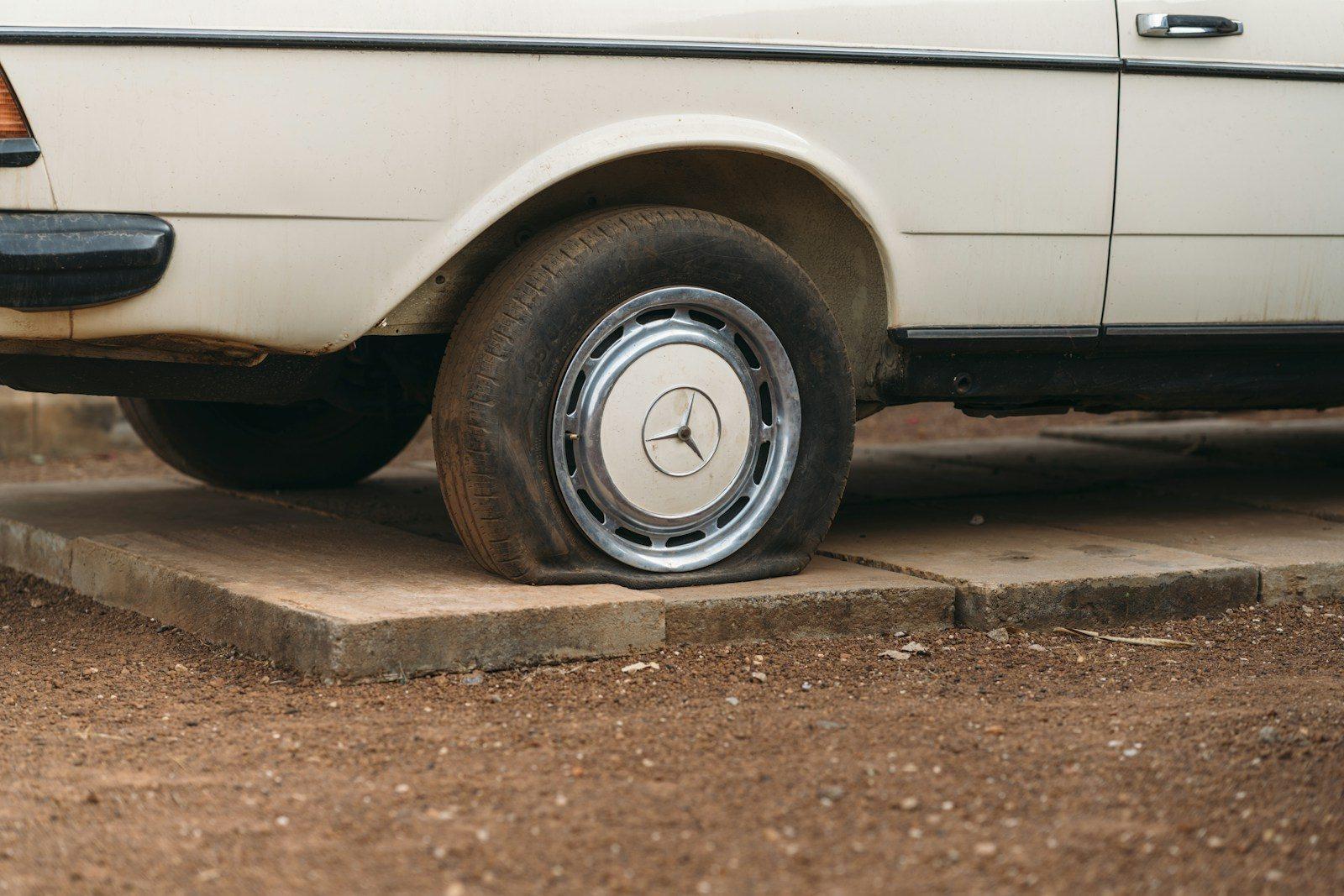
If it goes flat while you're driving
You might hear a thump, feel the steering pull to one side or see the tyre pressure warning light come on. Don't brake hard. Hold the wheel firmly, ease off the accelerator and let the car slow down gradually while you look for somewhere safe to stop.
- Signal early and get off the carriageway into a lay-by, side road, car park or wide verge. On a motorway or dual carriageway, only use the hard shoulder or an emergency area if you can't make the next exit.
- Put your hazard lights on. At night or in poor visibility, keep your sidelights on too.
- On a motorway or fast dual carriageway, get everyone out on the side away from the traffic and stand well back, behind the barrier if there is one. Don't try to change a wheel on the hard shoulder.
- Put on a hi-vis vest if you carry one. It's not a legal requirement in the UK, but it makes you far easier to see.
- Call for help and give your location as precisely as you can: road name, junction number, marker post or a what3words reference.
Can you drive on a flat?
Only as far as you need to get somewhere safe, and slowly. Driving on a fully flat tyre crushes the inside of the sidewall against the rim. Even a few hundred metres can ruin a tyre that could have been repaired, and it can damage the wheel too. If the tyre's low rather than completely flat, a careful drive at low speed to a safe spot is usually fine.
Run-flat tyres are designed to be driven on after losing pressure, usually for a limited distance at a reduced speed set out in your handbook. Stick to those limits. A run-flat that's been driven on deflated generally can't be repaired afterwards.
Spare, space-saver or sealant kit?
Lots of newer cars don't have a spare at all. Lift the boot floor and you'll find a full-size spare, a skinny space-saver, or a sealant kit with a little compressor.
- A full-size spare can be fitted and driven on normally. Only change a wheel well clear of traffic, on firm, level ground, with the handbrake on and the car in gear or Park.
- A space-saver is there to get you home or to a fitter. Most are limited to 50 mph and short distances, and the limit's printed on the wheel.
- A sealant kit can get you moving after a small hole in the tread, but it won't fix sidewall damage or big holes, and it makes a proper repair harder. Tell your fitter if you've used one.
If it's flat on the drive
This is the easy one. Leave the car where it is and book a mobile fitting. There's no need to pump it up and limp to a garage, and no need to wrestle with the jack yourself. We'll check the tyre, repair it if the damage allows, or fit a new one there and then.
Repair or replace?
It comes down to where the damage is and whether the tyre's been driven on flat. A nail in the middle of the tread is often repairable. A cut in the sidewall isn't. We take the tyre off the wheel, look inside and tell you straight. Our puncture repair article goes into the rules in detail.
What to tell us when you ring
- Exactly where the car is, and whether it's parked somewhere safe.
- Which tyre it is, and whether it's completely flat or just low.
- Whether you've driven on it since it went flat, and roughly how far.
- Your tyre size if you can read it off the sidewall, or your registration.
- Whether you've got the locking wheel nut key.
Rather we just sorted it?
We'll come to you, at home or at work. A small deposit books it and you pay the rest when we arrive.