
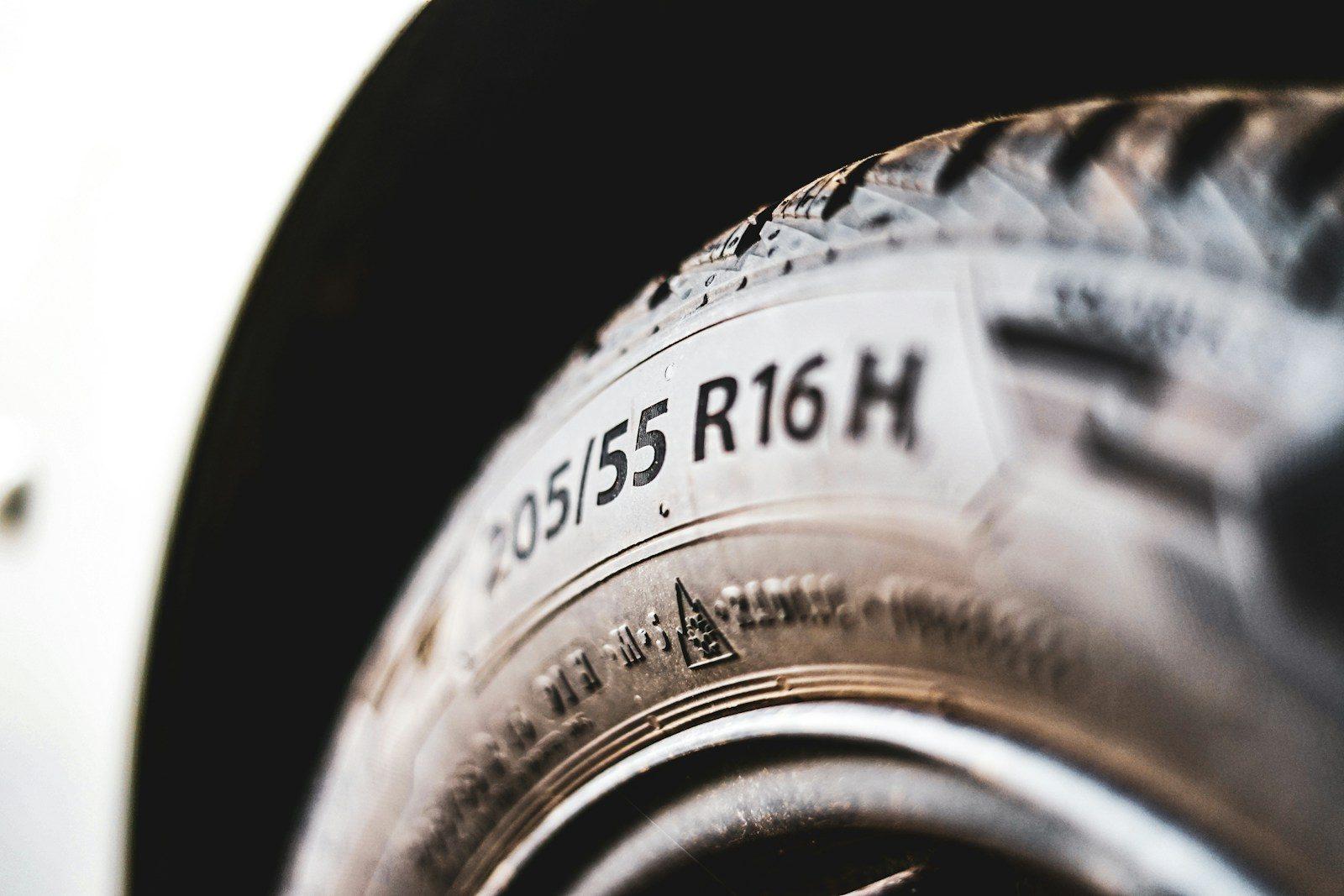
Reading the side of the tyre
Look at the outer face of the tyre. Among the brand name and other markings you'll find a sequence like width / profile R rim, followed by a load index and a speed rating letter. Using 205/55 R16 91V as the example:
| Marking | What it means | Example |
|---|---|---|
| 205 | Width of the tyre in millimetres | 205 mm wide |
| 55 | Profile: sidewall height as a percentage of the width | 55% of 205 mm |
| R | Radial construction, standard on modern car tyres | Radial |
| 16 | Rim diameter in inches | Fits a 16-inch wheel |
| 91 | Load index: the most weight each tyre can carry | 615 kg per tyre |
| V | Speed rating: the top sustained speed it's built for | Up to 149 mph |
Load index
The load index is a code, not a weight. A table converts it: 91 is 615 kg, 94 is 670 kg, 98 is 750 kg and so on. Your new tyre's index needs to be the same as or higher than your car maker specifies. A lower one isn't safe and can cause problems with your insurance. Some cars, especially heavier SUVs and vans, need tyres marked XL or Extra Load, which carry a higher index for the same size.
Speed rating
The letter shows the top speed the tyre's designed to sustain. On UK cars you'll commonly see T (118 mph), H (130 mph), V (149 mph), W (168 mph) and Y (186 mph). Like the load index, your new tyre should match or beat what the manufacturer specifies. It's about how the tyre's built and copes with heat, not a target speed.
Where else to look
- The tyre sticker inside the driver's door frame, on the fuel flap or the glovebox lid, which lists approved sizes and pressures.
- Your car's handbook, which usually lists standard and optional sizes.
- The other tyres on the car. Check all four, because mixed sizes are common on cars that have had tyres replaced one at a time.
- Our tyre size helper, which lets you build the size step by step and explains each part as you go.
Front and back can be different
Some performance and premium cars run wider tyres on the back than the front. Check both ends, and if they're different, tell us which axle you need.
Other markings worth knowing
- DOT code: a four-digit date code showing the week and year it was made, so 2324 is week 23 of 2024.
- M+S or the mountain-and-snowflake symbol: winter or all-season capability.
- RF, ROF, RSC or similar: a run-flat. Replace run-flats like for like unless the manufacturer says otherwise.
- An arrow or the word Outside: a directional or asymmetric tyre that has to go on a certain way round.
Rather we just sorted it?
We'll come to you, at home or at work. A small deposit books it and you pay the rest when we arrive.